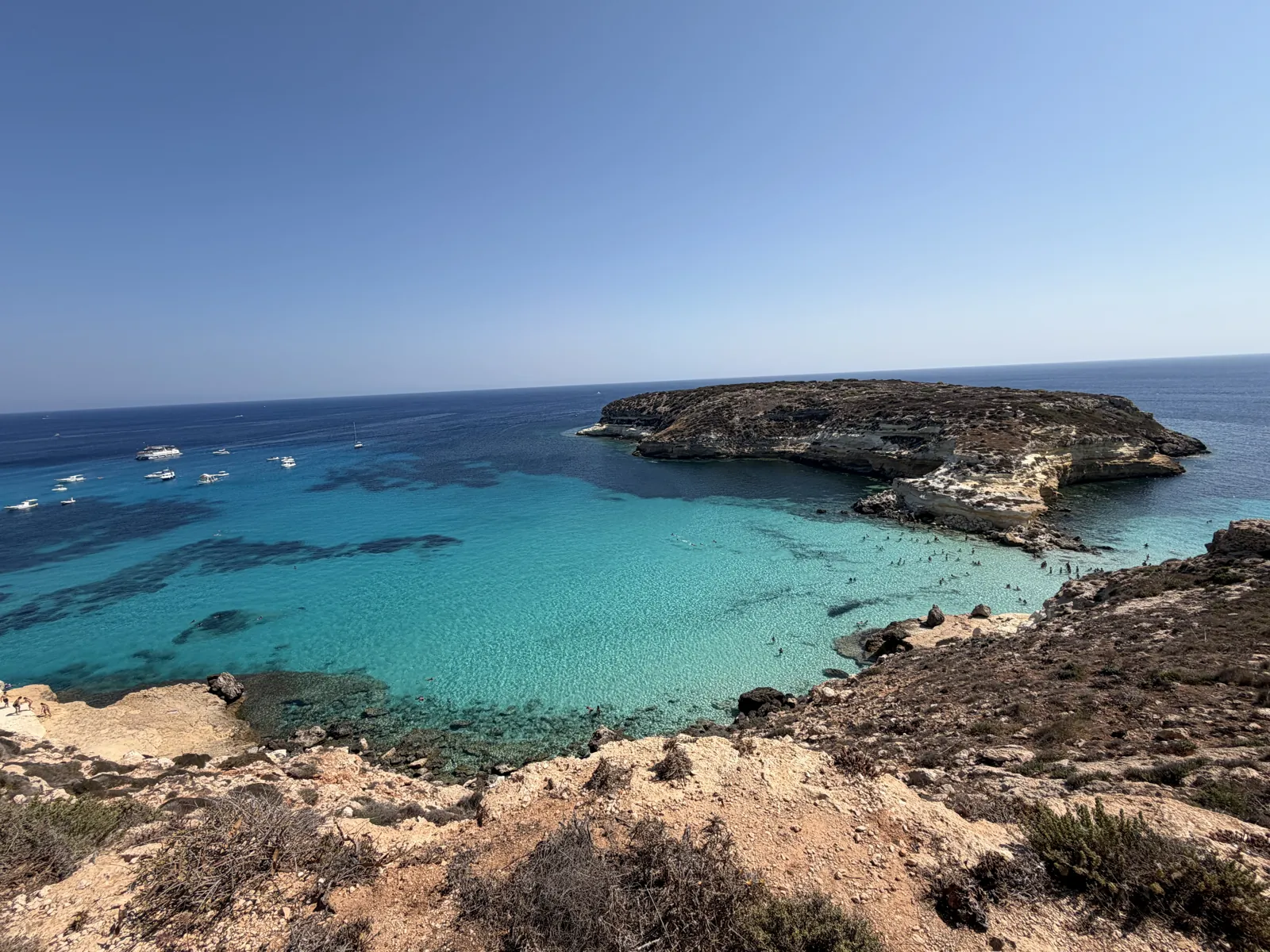
On a small island, little more than a rock, there is a group of guardians in yellow who take turns watching over what Mother Nature has built. Guardians of new lives, they make sure, day after day, night after night, that every little turtle reaches the water safe and sound. Guardians of those first, and perhaps last, flipper tracks in the sand.
It was March 20, 2026. At eight o’clock sharp in the morning I was, as usual, already at my computer, getting on with my projects with energy and a clear head. An email lands in my inbox. It is Rossella from Legambiente, writing: “Hi Stefano, spoiler: this is not the usual summer.” Damn, was she right, but I didn’t know it yet. The email says the summer volunteer camps are online. OK, interesting: let’s see more… There is Tolentino in the Marche, the Valley of the Temples in Agrigento, sailing to the island of Elba. All wonderful, but then I read: “In Lampedusa you can have an experience you won’t forget.” And who am I to back out? I click the button, the sign-up page opens and I go ahead. At 3:32 p.m. the confirmation arrives: “Hi Stefano, you have booked the volunteer project Lampedusa, l’isola delle Tartarughe, from 31-07-2026 to 09-08-2026, with the ID code Vol07.” Perfect: being a good organizer and a control freak, I book the flight, put everything in the calendar and buy what I need: a red flashlight, a light sleeping bag. See you at the end of July, for the first time, at the southernmost point of Italy.
I didn’t yet know exactly what I was looking for, but I felt the time had come for an experience like this. At that point in my life I was ready to put myself out there, to get to know new people and places, and to discover volunteering not just from the outside but by living it first-hand.
The months go by quickly, between commitments and projects. The departure date gets closer, and in the meantime I start getting to know the island better. Lampedusa is much closer to Africa than to Sicily: a land of barely twenty square kilometers, with a high, steep northern coast and a southern one that slopes down to beaches and sandy coves. What strikes me most is discovering how protected it is: since 1996 much of the southern coast has been a Nature Reserve, managed by Legambiente Sicilia, and since 2002 there has also been the Pelagie Islands Marine Protected Area. It is a small, fragile territory, on land and at sea, and I begin to understand why every presence has to find a balance with what surrounds it.
On July 31 the start is early: a train from Piadena at seven in the morning, changing at Milano Centrale, to reach the Milan airport terminal before ten. The plane doesn’t leave until one. The A321neo, comfortable and colorful, takes off and from the window immediately shows me the Seveso park, the Monferrato, the Ligurian coast, where I recognize Lerici straight away, the island of Elba and then only sea. Then we fly over some islands: I will find out later that they are Favignana, Pantelleria and finally Linosa, before sighting, at last, Lampedusa.
During the landing the island really does look like little more than a barren rock. Leaving the “airport”, not much bigger than the gym of my town’s primary school, I immediately see the Reserve’s little green Panda with “Regione Siciliana” written in yellow, and Sofia, the camp’s deputy coordinator, who greets me with enthusiasm. Other members of the camp are there too, and together we set off for what will be our home for the next ten days. The drive also lets us see a few streets of the town center, which is not very different from the little I have seen of Sicily: low houses, flat roofs, balconies and that characteristic disorder that speaks of a lived-in place and human warmth. After meeting the rest of the group and the coordinator, Emma, we reach the headquarters of the Isola di Lampedusa Nature Reserve. Here Elena, the biologist in charge, and Gerry, a member of the Reserve staff, tell us the history and features of the protected area and introduce us to the biology of Caretta caretta. That is the moment we really understand what awaits us: the Spiaggia dei Conigli is not just a beautiful and very busy place, it is also a nesting site for a rare and threatened species. Our task will be to help maintain the right conditions for the laying and hatching of the eggs, limiting as far as possible the impact of people on the beach.
They explain that we will alternate day and night shifts. By day we will watch the nests, talk to the public, remind beachgoers of the Reserve’s rules and clean the beach by hand. When needed, we will also lend a hand at the info point and with managing the entrances. At night, we will stay on the beach to check the nests during the hatching period.
Since 2021 access to the Spiaggia dei Conigli has been capped, precisely to protect such a delicate environment from the pressure of mass tourism. There is a morning slot and an afternoon slot, and we volunteers will also help manage visitors coming in and going out. Camp life, of course, also includes very practical things: we will take turns preparing the meals and cleaning the accommodation.
My first shift is the next day, in the afternoon. In the evening we eat at home something prepared by the group before us. The next morning we make a quick trip to the Guitgia (a nearby beach). At 1 p.m. sharp we leave in the little Panda for the Spiaggia dei Conigli. In Lampedusa, forget about air conditioning, locked front doors, car doors that close, windows that wind up and fastened seat belts. It’s just not a thing. When we reach the entrance checkpoint, we can already see people queuing for the 2:30 p.m. slot. They notice us “yellow shirts”, with Legambiente’s symbol, a green swan, in plain view, and on the back the slightly optimistic words: “TUTTO PUÒ CAMBIARE” (everything can change). The onlookers frown a little at seeing us walk in undisturbed, but they soon understand that we are “in the business”. Only to be amazed when they find out that we are all volunteers (we yellow shirts, at least).
Gerry asks me to stay at the upper checkpoint to help with the entrances. We let about ten people at a time move on toward the checkpoint, first those with a booking and then the last-minute arrivals. A maximum of 550 people per slot, 465 of them bookable online, the rest queuing to “try their luck”. Then I run down for the welcome. At the entrance we explain that the beach is in the Reserve and the sea in the Marine Protected Area. In theory we shouldn’t even be there, were it not for an exemption. No smoking, not even e-cigarettes; no inflatable mattresses, no ball games or beach rackets, no firearms, no fishing, no loud music, no feeding the fish, no deckchairs, and no going beyond the boundary ropes or the buoys. “It’s a wonder we let you breathe…”, I sometimes joke with someone. There is an area with umbrellas and one without, and respecting the distinction is non-negotiable. “We’ll be waiting for you at the nests.” Needless to say, everyone comes by and asks: “But when do the turtles hatch?” “Can we see them?” “We’re coming with you tonight!” There is magic on that beach, and everyone would like to feel it.
But before you get down to the beach there is the path, about 10 minutes for the quickest. Before the last descent you pass the viewpoint, and that is where you realize you are standing before a wonder of Mother Nature. When you look out over that isthmus for the first time it is impossible not to get goosebumps; you are simply left speechless.
The shift goes quickly. We politely call out the few rule-breakers, one or two for an inflatable mattress and more than one for those e-cigarettes that stink of… you get the idea! The best part is talking to people at the nests, answering the questions of all those very curious, fascinated visitors. At one point someone asks: “You’re biologists, right? How many years did you study to know all this?” And the answer: “I studied computer science, actually, but I paid attention last night during the two hours of training. My memory’s still good, you know!” (Thanks again, Elena and Gerry.)
Around 6:45 p.m. we start cleaning the beach; people see the yellow shirts moving across the sand and understand that their time is almost up; some head for the shore of their own accord. The boldest are asked to leave the water at 7. The climb is demanding for the less fit, and at 7:30 we have to close, but we almost always manage to be on time (apart from the odd ritual last photo at the viewpoint).
The morning shift is not very different; the beach is certainly more enjoyable, thanks to the milder temperature. In the afternoon it is very hot. What is completely different is the night shift. We go down last, when everyone else has already come up. We enjoy the sunset light at the viewpoint, with the sky catching fire behind the headland that hides Cala Pulcino. We wait for the Jeep driven by Enzo, also a member of the Reserve staff. Together we tackle the last stretch of the descent, helping each other carry the equipment down, and set up camp: the tents, the dinner area and, above all, the area for recording the biometric data of our beloved little Caretta caretta. Here weight, length, width and other data on the carapace are recorded and then sent to ISPRA (the Italian Institute for Environmental Protection and Research) for statistical purposes.
With the last glimmers of light we have dinner together, lunchboxes and Peroni. Then we lie down to watch the stars and the Milky Way and to count shooting stars. The light of the buoy marking the marine area has pulsed since 2002, every five seconds, marking the passing of time, while there time seems to have stopped. The day has been demanding, but it is impossible to go to sleep before four, in the company of the sky and of conversation with the other volunteers. We are where everyone would like to be: it is a privilege reserved for volunteers, together with the duty of checking the nests every twenty minutes. The wait is long, but at midnight, punctual as a clock, something moves in the shadows. I switch on my red light (so as not to dazzle the little armored ones) and shine it on the guard placed over the nest. The nest is buried several centimeters under the sand, but a plastic guard marks off the area and stops the turtles from scattering, among the tourists by day or the ghost crabs by night. Inside the guard, little Caretta caretta are swarming. I stay a few seconds to watch, for the first time, the birth of new marine life. Then I run to call Ludovica, the biologist on shift with us. Gently, armed with sterile gloves, she picks up the 18 newborns and puts them in a plastic basin already filled with sand. We carry everything to the measuring station. Once the biometric data have been taken, the moment comes to set them free. We check the shoreline, still with the red light, and chase away the ghost crabs, ready to feast. And then, stroke after stroke of their flippers, the little ones head for the sea of their own accord, following the natural slope of the beach, the sound of the waves and the light of the moon now reflected on the surface of the Mediterranean. One at a time they take to the sea, gently waiting for the right wave to carry them offshore. Among those eighteen there are probably both males and females. For the males it has been a brief experience on dry land: they will never touch land again; their life will be among the waves forever. The females are left with the hardest job: after twenty or thirty years they will be big enough to lay eggs. These animals, which will reach a maximum weight of 180 kg, will return to sandy beaches once a year to lay about a hundred eggs. They dig a deep nest, lay the eggs and, covering the hole, ask the beach and the sun to do the brooding for them for fifty or sixty days. A small promise that works, until the moment of hatching, when we “guardians in yellow” watch over those first, and perhaps last, little flipper tracks in the sand.
The night goes quickly and the glow of dawn begins to set the eastern sky on fire. We take turns checking the nests, but that is all for the night. Some manage to rest. I manage to sleep a couple of hours, until six. Then Mother Nature surprises us again. In the sand, on the opposite side of the beach, we see the characteristic “track”. A big one came during the night without anyone noticing and laid a nest, the fourteenth. It was the night between August 2 and 3. Unfortunately the spot is not ideal: it is too close to the water and in the middle of the umbrella area, with the risk that the shade will compromise the hatching of the eggs. Elena comes down with Peppino. It is immediately clear that the nest has to be moved. But first it has to be found. After laying, loggerheads disguise their tracks well. The biologists and the Reserve staff gently feel the ground, removing perhaps a centimeter of sand at a time and brushing it with a light hand to find the exact spot. At last the nest is found and the fifty-six eggs are moved to a better part of the Spiaggia dei Conigli. There the nest is recreated with the same dimensions, the same shape and the same depth, to replicate what the turtle made. The hatching is now due in October.
We volunteers slowly start up the climb. Our shift is over, but we have just lived the most special night of our lives: emotion, adrenaline and a deep sense of connection with our planet and with a cycle that has gone on for millions of years. Now it is up to us to protect this cycle of life, mainly from ourselves.
The group of volunteers grows ever closer. We get to know each other and learn to enjoy being together: some laugh, some hug, some cook, some smile and some play pranks. Aperitifs, shared dinners and laughter alternate with the small mishaps of communal living: someone snores, someone else is saved by earplugs. One day the water runs out across the whole island and we make do with wet wipes. Meanwhile on the beach, in the middle of the night, even the crabs seem to enjoy playing a few tricks on us. They are inconveniences that complicate things in the moment and, a little later, become stories to tell while laughing.
Camp life is work, but it is also being together, exploring other parts of the island, going out by boat, drinking a Negroni at sunset; some even manage to explore Linosa, the other island in the same municipality, although geographically the two islands sit on two different continents.
On the last evening we all eat pizza together at the entrance to the Reserve. The next morning is departure day. I am not on shift, but I have already got everything ready to leave. I arrive at the checkpoint before opening and say goodbye to all the wonderful people on the Reserve staff: biologists, ticket office staff and collaborators.
I go down shortly before opening and do an hour or so of welcoming, an essential part of getting visitors to cooperate. After repeating the rules and welcoming the 550 people coming in, we do one more quick round of checks. The girls on shift that morning thank me warmly for lending them a hand. It is time for a short swim in that crystal-clear sea and then to say goodbye, at least for now, to that beach.
After the climb I go back to the house to get my suitcase and wait for Enzo, who will take me to the airport in the Jeep. The moment comes to say goodbye to the other volunteers and the camp coordinators. It is a touching moment, but everyone lives it in their own way, with their own emotions and at their own pace. Some are moved to tears; others put everything into a hug or a few words.
The camp lasts ten days. The guardians in yellow change, stint after stint, but they have one thing in common: they leave a part of their heart on that beach, waiting to find it again the following year. They arrive for the first time in an unknown setting, made up of strangers, but when they leave they know they have left behind a second family and a part of themselves. Only there will they be able to find it again.
I go home wanting to do more volunteering and wishing to return to that very camp. I feel closer to people and less shy toward the world, a little more ready to meet it instead of watching it from a distance.
Special thanks to Legambiente, to the coordinators Emma and Sofia, to the marine biologists Elena and Ludovica, to the Reserve staff — Enzo, Gerry and Peppino — and to the volunteers Anna, Bakhita, Cristiana, the two Francescas, Giorgia, Ilaria, Linda, Maria, Patrizia, Rebecca, Ruth and Valentina.
To find out about the volunteer camps and choose one: Legambiente’s volunteering portal.